Anna Atkins — Impressions in Blue
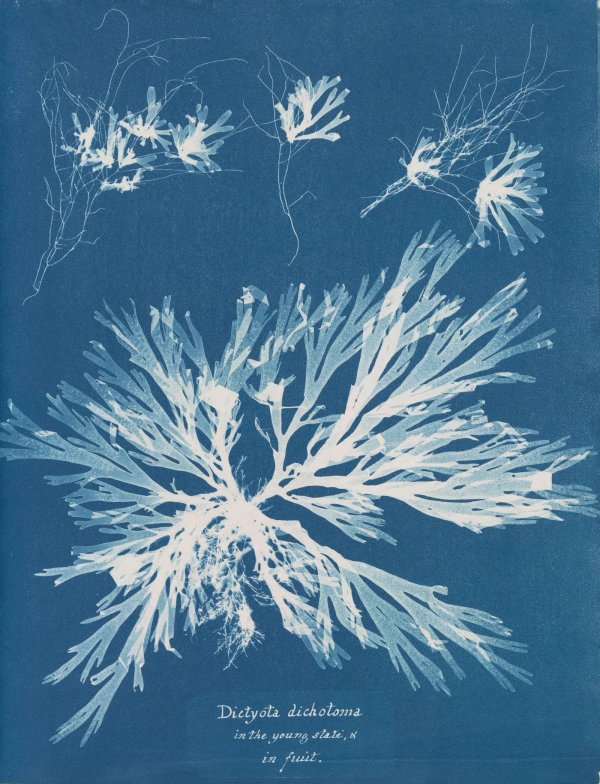
Dictyota dichotoma, 1850 [3]↓
Anna Atkins (1799–1871) was an English botanist and one of the earliest practitioners of photography. Her Photographs of British Algae: Cyanotype Impressions, issued in hand-stitched fascicles between 1843 and 1853, is widely regarded as the first book illustrated entirely with photographic images. Working with the cyanotype process developed by Sir John Herschel in 1842, she produced contact prints of pressed algae, ferns, and flowering plants — white botanical silhouettes against deep Prussian blue — that served simultaneously as scientific records and as some of the most visually distinctive images of the nineteenth century.
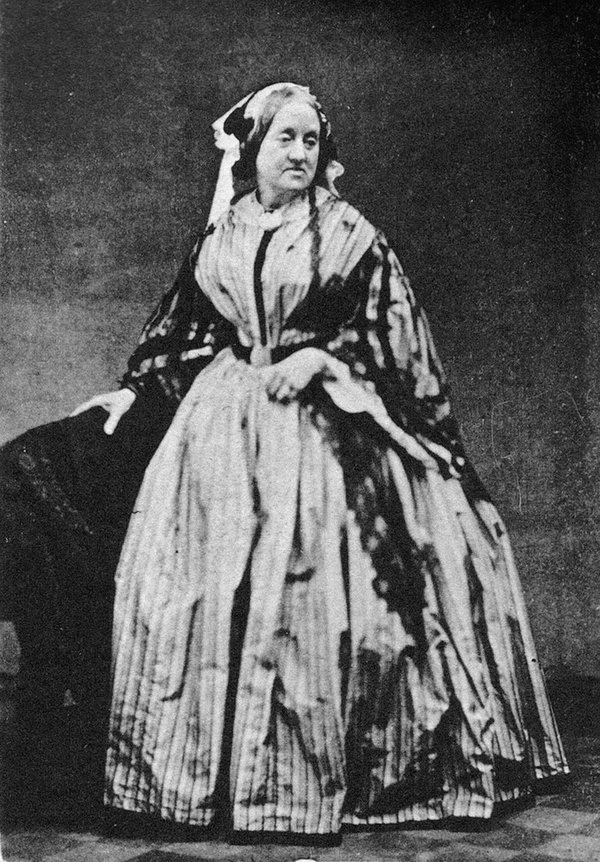
Portrait of Anna Atkins, albumen print, 1861 [1]↓
From Scientific Networks to a New Medium
Atkins grew up in close proximity to British scientific culture. Her father, John George Children, was a Fellow of the Royal Society who worked in the natural history collections at the British Museum, and through his networks she encountered the leading naturalists and experimenters of her time. It was through these connections that she became aware of Sir John Herschel's cyanotype process — a blueprint method based on the light-sensitivity of ferric ammonium citrate and potassium ferricyanide — shortly after Herschel first demonstrated it in 1842. Where others saw a copying technique, Atkins recognized an imaging tool: a way to record plants directly, without a lens, a camera, or a draughtsman.
How the Cyanotype Process Works
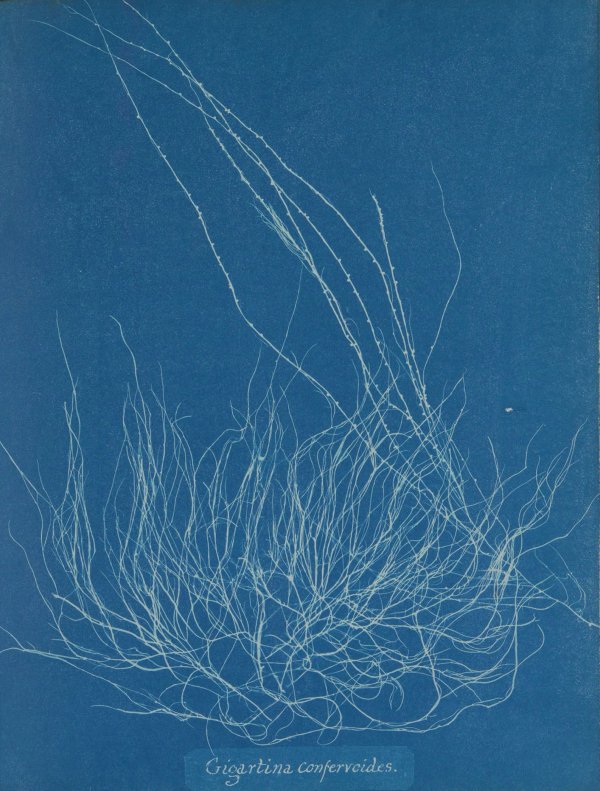
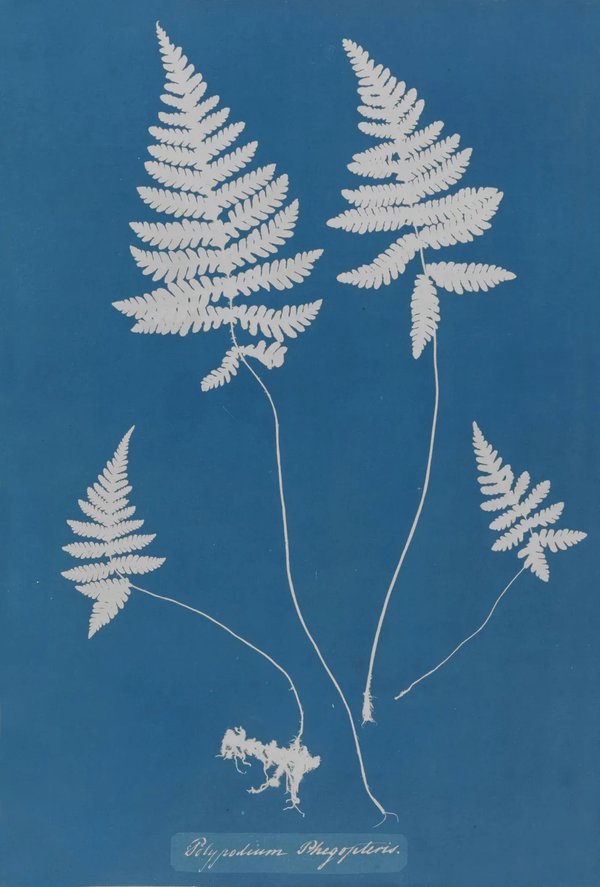
To make a cyanotype, Atkins coated paper with a solution of light-sensitive iron salts, then placed a pressed botanical specimen directly onto the surface. The sheet was exposed to sunlight: where the plant blocked the light, the paper remained pale; where the UV rays struck the iron compounds, they reduced and reacted to form an insoluble blue pigment — Prussian blue. A simple rinse in water fixed the image permanently. No darkroom, no fixer, no enlarger. The contact print preserved the actual size and structure of the specimen with a fidelity that hand-drawn illustration rarely achieved: fine fronds, veining, surface textures, and reproductive structures all rendered in a single exposure.
Photographs of British Algae — The First Photographic Book
Between 1843 and 1853, Atkins issued Photographs of British Algae: Cyanotype Impressions in hand-stitched fascicles, sent privately to a small circle of botanical friends and scientific contacts. There was no printing press, no publisher, no commercial distribution. Each copy was unique in its number and arrangement of plates — across the decade of the project, Atkins made thousands of individual prints by hand. Only around thirteen substantially complete copies are known to survive today. For each plate, she typically arranged the same specimen in multiple orientations on the sheet, sometimes adding a handwritten or printed caption, allowing viewers to study three-dimensional structures — fronds, branching patterns, holdfast anatomy — flattened into a single continuous image. The prints functioned simultaneously as visual records and as working references for identification, accurate in scale and proportion in a way that woodcut or engraved illustration could not guarantee.
The book is now held in collections at the British Library, the Natural History Museum London, the New York Public Library, and MoMA, among others.
Ferns, Grasses, and the Later Botanical Work
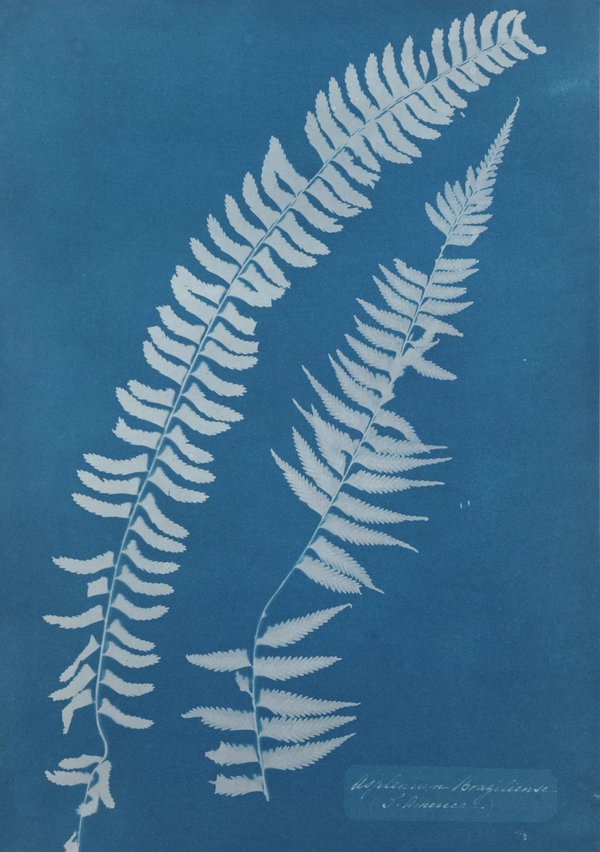
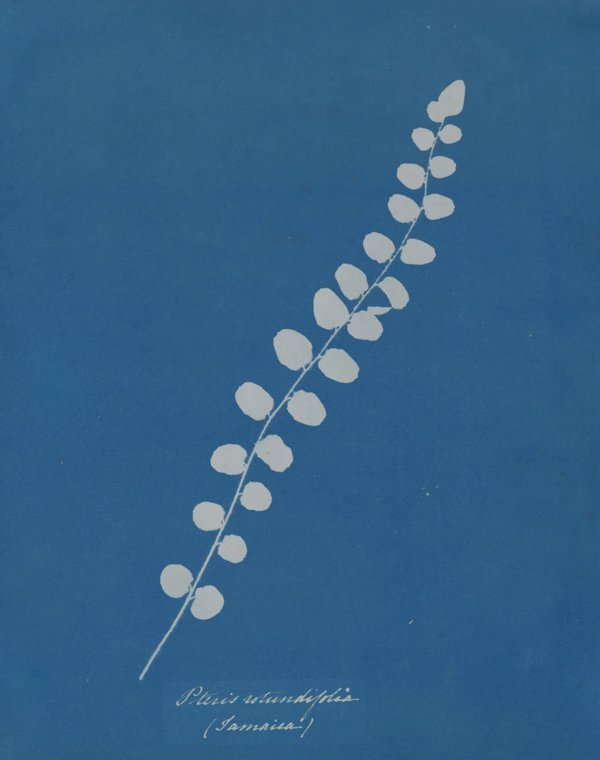
Beyond the algae project, Atkins continued to produce cyanotypes of ferns, grasses, and flowering plants, often in collaboration with her friend and fellow collector Anne Dixon. These later works show a growing awareness of tone and composition — specimens carefully spaced, forms allowed to overlap in ways that enhance legibility without sacrificing scientific accuracy. The fern prints in particular, including Polypodium Phegopteris (1853) and Pteris Rotundifolia (1853), demonstrate a command of the medium that goes beyond documentation: the translucent quality of pressed fronds against deep blue produces images that sit clearly at the intersection of scientific record and visual art.
Anna Atkins and the History of Botanical Imaging
In the longer history of botanical image-making, Atkins' significance is twofold. First, she established photography as a viable tool for systematic scientific documentation at a moment when the medium was barely two years old. Second, she demonstrated that direct contact between specimen and light-sensitive surface could produce records of a precision and reproducibility that neither illustration nor verbal description could match. This principle — the plant itself as the image-making instrument — connects her work directly to later photogram traditions, to the botanical scans and backlit specimens that form part of contemporary practice, and to the ongoing question of what it means to make a true record of a plant. Her cyanotypes are not illustrations of nature. They are impressions made by nature itself.
Sources
- [1] Portrait of Anna Atkins, albumen print, 1861, RPS Yorkshire, via Wikimedia Commons[Link](accessed: 2026-03-01)↑
- [2] Gigartina confervoides, Public Domain, Wikimedia Commons[Link](accessed: 2026-03-01)↑
- [3] Dictyota dichotoma, Public Domain, Wikimedia Commons[Link](accessed: 2026-03-01)↑
- [4] Polypodium Phegopteris, MoMa Collection; David H. McAlpin Fund[Link](accessed: 2026-03-01)↑
- [5] Asplenium Braziliense, Public Domain, Wikimedia Commons[Link](accessed: 2026-03-01)↑
- [6] Pteris Rotundifolia, MoMa Collection, David H. McAlpin Fund[Link](accessed: 2026-03-01)↑