Fox Talbot — The First Reproducible Plant Photographs
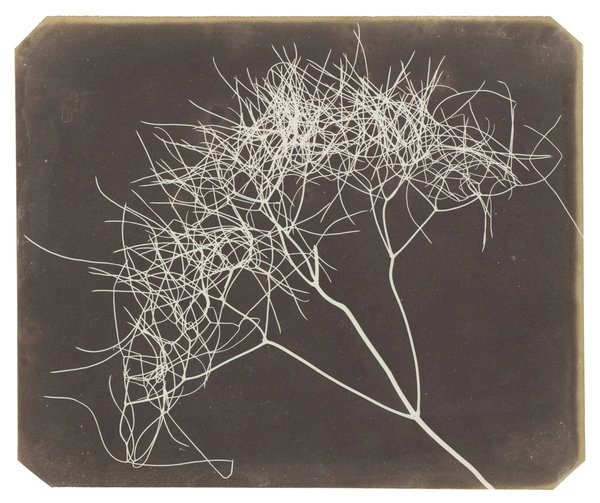
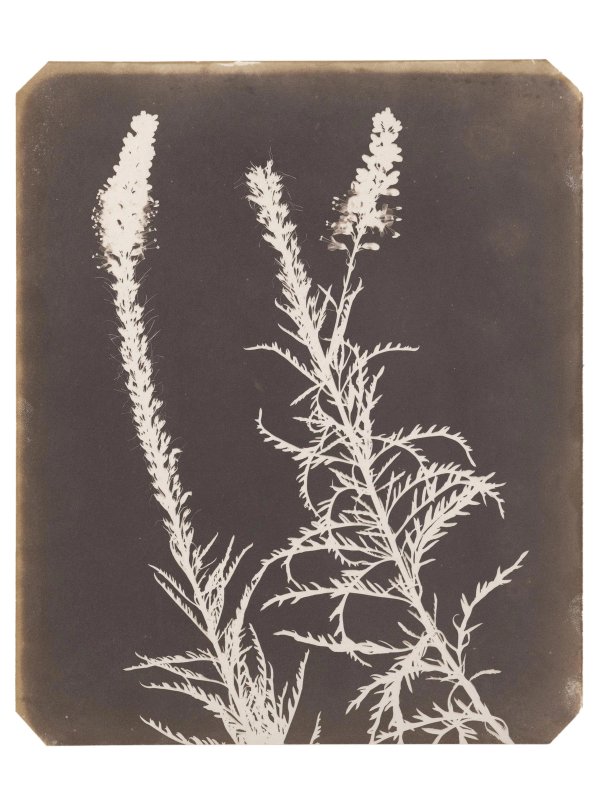
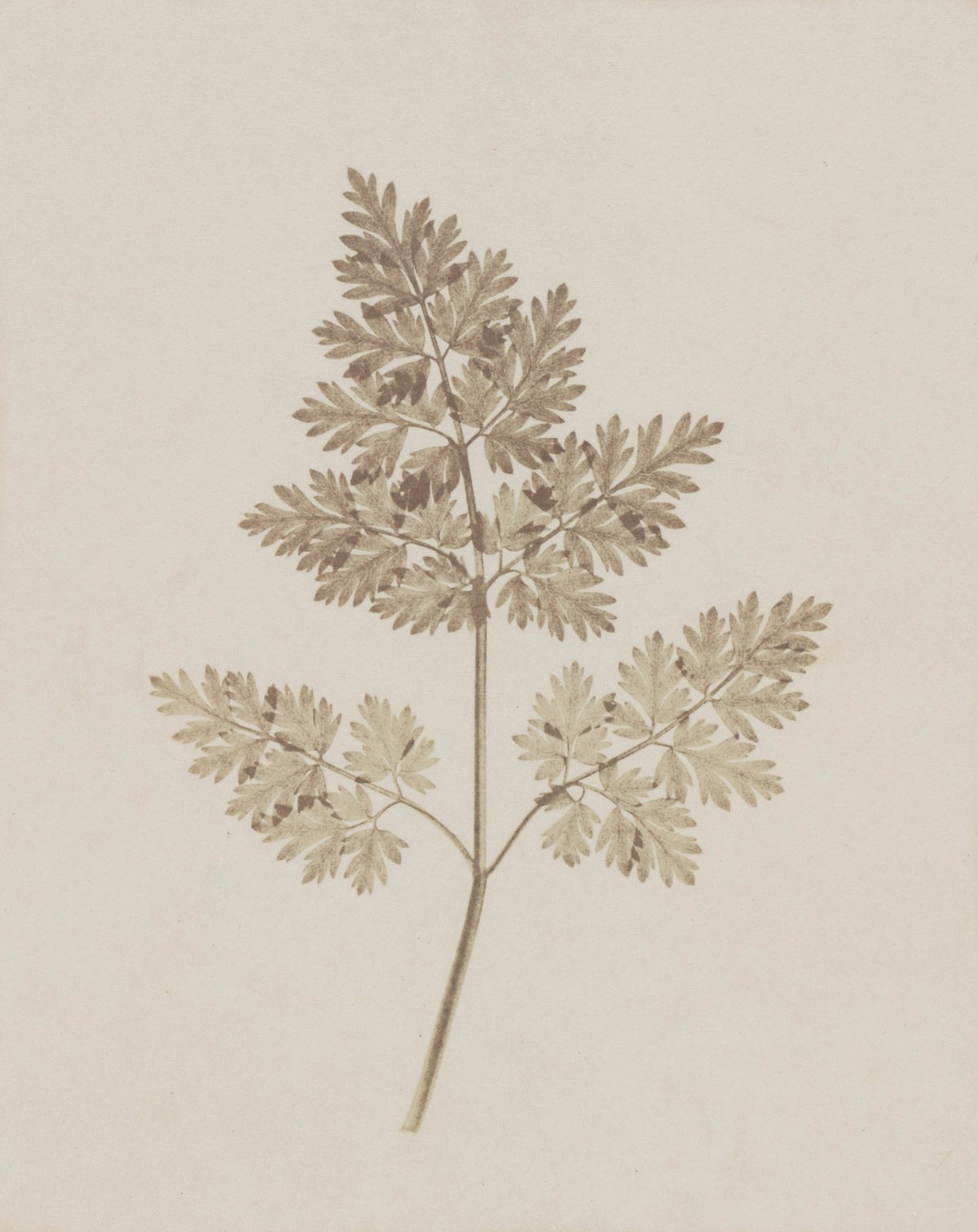
Wild Fennel, William Henry Fox Talbot, 1841-1842 [3]↓
In October 1833, William Henry Fox Talbot sat on the shores of Lake Como attempting to sketch the landscape through a camera lucida — a prism-based drawing aid that projects a faint image onto paper. The results were, in his own words, "melancholy to behold." The faithless pencil refused to follow what the eye could see. That failure stayed with him. Back at Lacock Abbey in Wiltshire, he began asking a different question entirely: what if light itself could do the drawing? The answer, reached through years of patient experiment, was the calotype — the negative-positive paper process that became the technical foundation of nearly all photography that followed.
From Sketching Failure to Photogenic Drawing
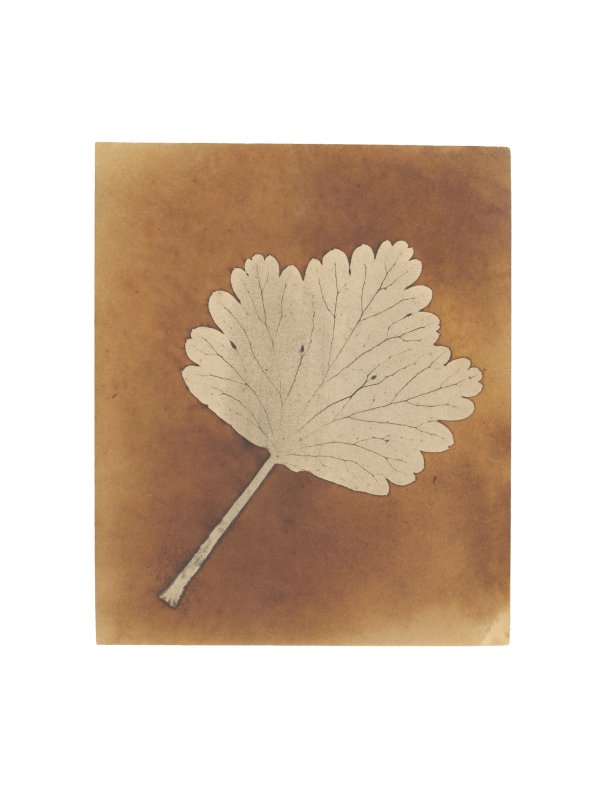
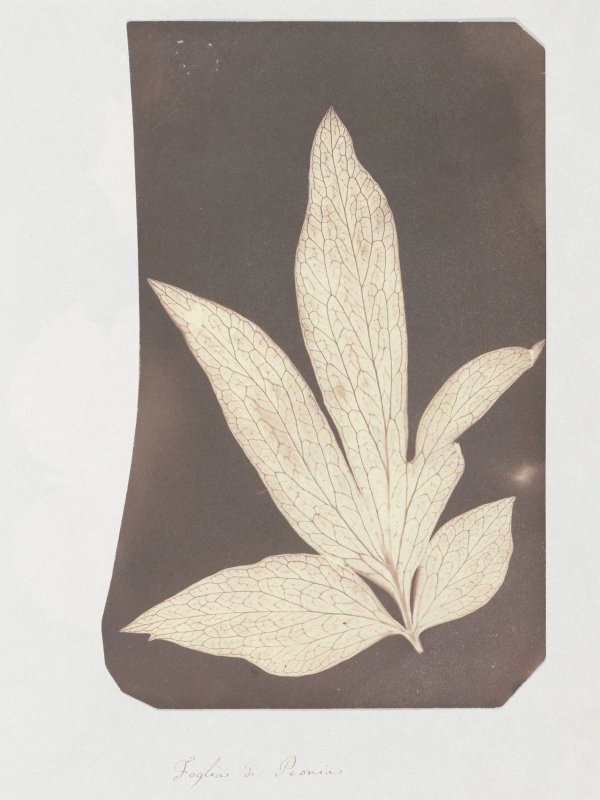
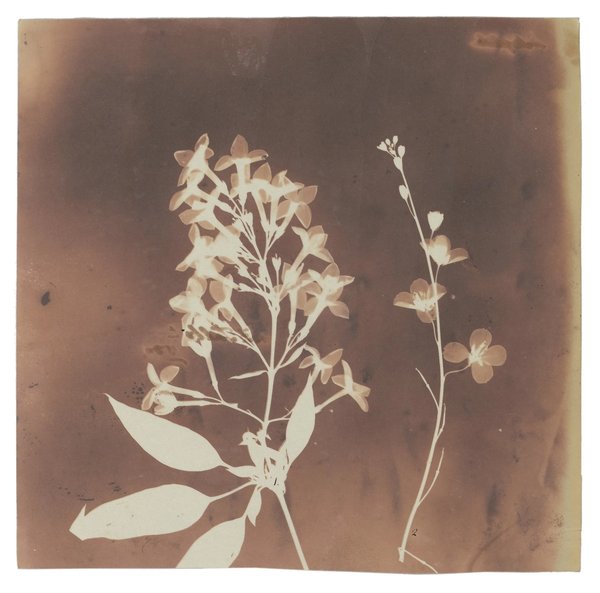
Talbot's first experiments, developed from 1834 onwards, produced what he called "photogenic drawings." He coated paper with silver chloride, placed botanical specimens — leaves, ferns, pressed flowers — directly on the surface, covered them with glass, and set them in sunlight. The plant blocked the light; the surrounding paper darkened. What remained was a white silhouette of the specimen, precise in outline, faithful to every vein and edge. It was not a drawing made by a human hand. It was an impression left by the plant itself on light-sensitive paper — a distinction Talbot understood immediately and that would define botanical photography for the next century. These early photogenic drawings are among the first images in the history of photography, and plants were their primary subject.
The Calotype Process — A Technical Breakthrough
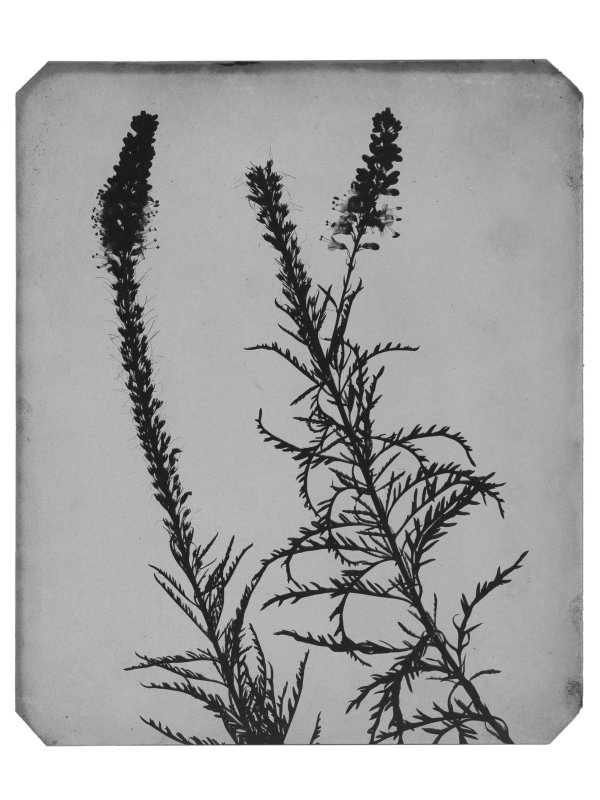
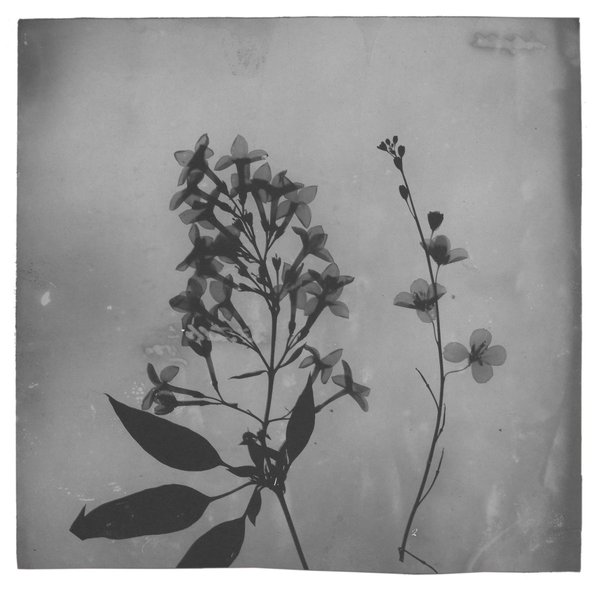
The calotype, patented in 1841, solved what photogenic drawing could not: it allowed a camera to be used, not just direct contact. Paper was first iodized with silver nitrate and potassium iodide, forming light-sensitive silver iodide. Before use, Talbot brushed on a second solution — gallic acid and silver nitrate — which dramatically increased the paper's sensitivity to light. Loaded into a camera obscura, the treated sheet needed only one to two minutes of sunlight to register a latent image, invisible at first, brought out by a further wash of gallic acid after the exposure. The result was a paper negative: translucent, often waxed for clarity, from which any number of positive prints could be made by contact. This was the decisive invention — not a single fixed image, like the daguerreotype, but a reproducible process. One negative, infinite prints. The logic of all subsequent photography flows from this.
The calotype's characteristic quality — a soft, fibrous warmth quite unlike the mirror-sharp daguerreotype — came from the paper itself. Its grain absorbed light rather than reflecting it. Botanists and scientists sometimes preferred the daguerreotype's precision; artists and those working with specimens found the calotype's tonal depth better suited to the delicate structure of leaves, petals, and stems.
Leaf, William Henry Fox Talbot, 1844-1846 [6]↓
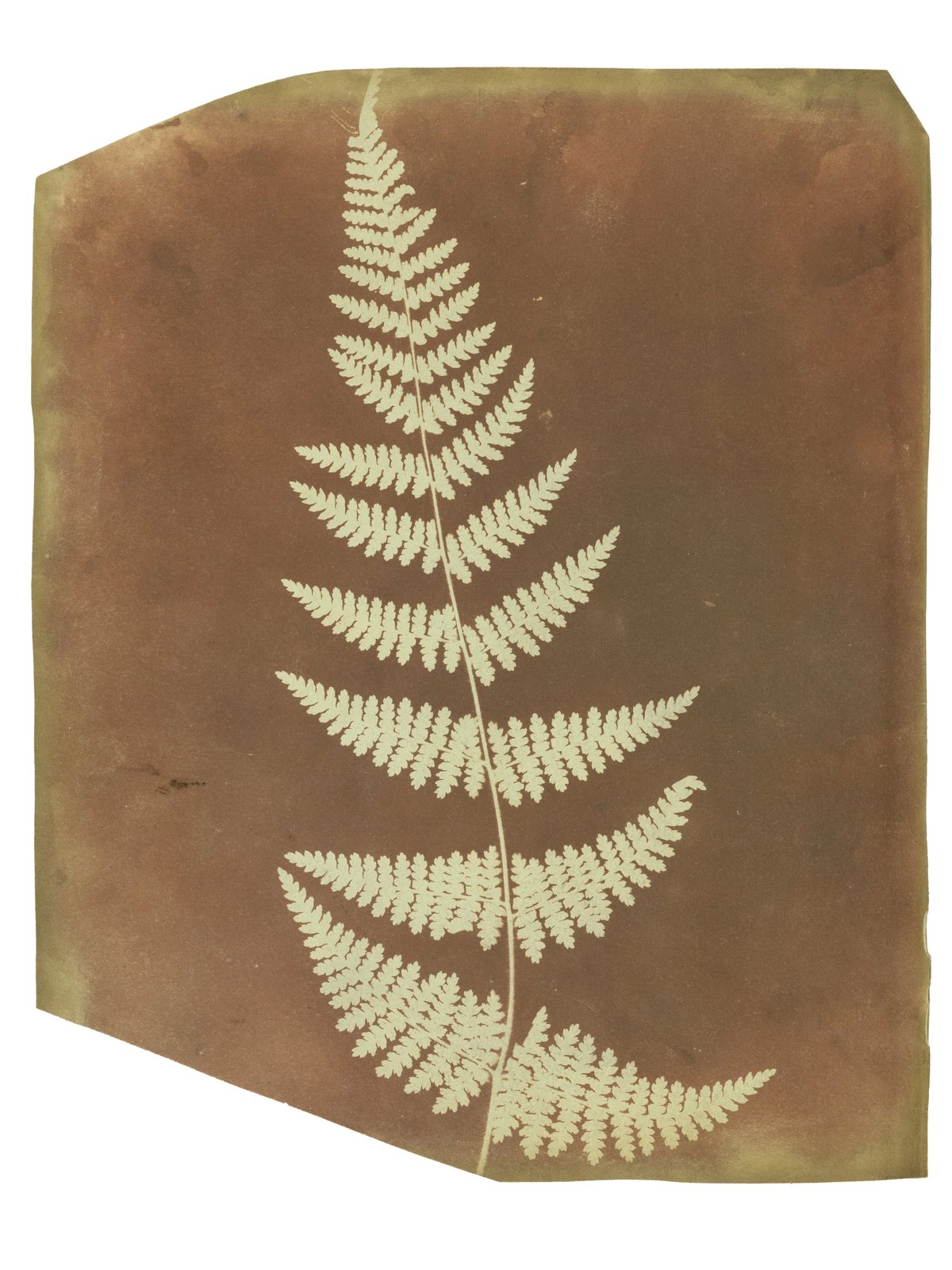
Buckler Fern, William Henry Fox Talbot, 1839 [7]↓
Plants as the Primary Subject
From the very beginning, Talbot's botanical instinct was inseparable from his photographic practice. The gardens and grounds of Lacock Abbey provided him with an endless supply of subjects: leaves, ferns, flowering plants, pressed specimens from the estate's walled garden. He photographed them in both modes — placing specimens directly on sensitized paper as photograms, and capturing them through the camera as calotype negatives. The results were different in character but shared the same ambition: to record the structure of a plant with a fidelity that no illustrator's hand could match.
His peony leaf from 1839, his buckler fern, his wild fennel from 1841–42 — these are not decorative images. They are attempts at precision, at capturing the exact geometry of a plant's form: the branching of a stem, the serration of a leaf edge, the way light passes through a petal. Talbot understood that photography offered botany something illustration never could — not interpretation, but fact. He shared the calotype process freely for scientific purposes and envisioned its use in botanical cataloguing, herbarium documentation, and the visual archiving of plant collections. That vision took decades to fully realise. But the images he made at Lacock Abbey in the 1830s and 40s established, for the first time, that a plant could be its own document.
The Pencil of Nature and the Botanical Plate
In 1844, Talbot began publishing The Pencil of Nature — the first commercially published book illustrated with photographs, issued in six fascicles through 1846. Several of its plates depict botanical subjects directly: leaves, stems, specimens arranged with the same quiet care he had applied to them in the gardens at Lacock. The book's title was itself botanical in its metaphor: nature, given the right tools, could draw itself. The calotype, Talbot argued, was not a human medium. It was a physical process by which the world left its own impression on treated paper — a form of contact as direct as pressing a plant between the pages of a book.
Sources
- [1] Leaf, William Henry Fox Talbot, ca. 1840, Public Domain, Wikipedia Commons[Link](accessed: 2026-03-06)↑
- [2] Foglia di Peonia, William Henry Fox Talbot, 1839, Public Domain, Wikimedia Commons[Link](accessed: 2026-03-06)↑
- [3] Wild Fennel, William Henry Fox Talbot, 1841-1842, Public Domain, Wikipedia Commons[Link](accessed: 2026-03-06)↑
- [4] Veronica in Bloom William Henry Fox Talbot, Public Domain, Wikimedia Commons[Link](accessed: 2026-03-06)↑
- [5] Cestrum Parqui, Fiora di una tetradinama, William Henry Fox Talbot, 1839, Public Domain, Wikimedia Commons[Link](accessed: 2026-03-06)↑
- [6] Leaf, William Henry Fox Talbot, 1844-1846, Public Domain, Wikimedia Commons[Link]↑
- [7] Buckler Fern, William Henry Fox Talbot, Public Domain, Wikimedia Commons[Link](accessed: 2026-03-06)↑